Implicit Grant
The Implicit grant is one of the OAuth 2.0 grant types supported in ReadyAPI. This grant is similar to the Authorization Code Grant, but instead of using the code as an intermediary, the access token is sent directly through a browser redirect.
To configure OAuth 2.0 authentication in ReadyAPI, see Enabling OAuth 2.0 Authentication or Enabling OAuth 2.0 Authentication with Azure Active Directory.
 |
 |
Option | Description |
|---|---|
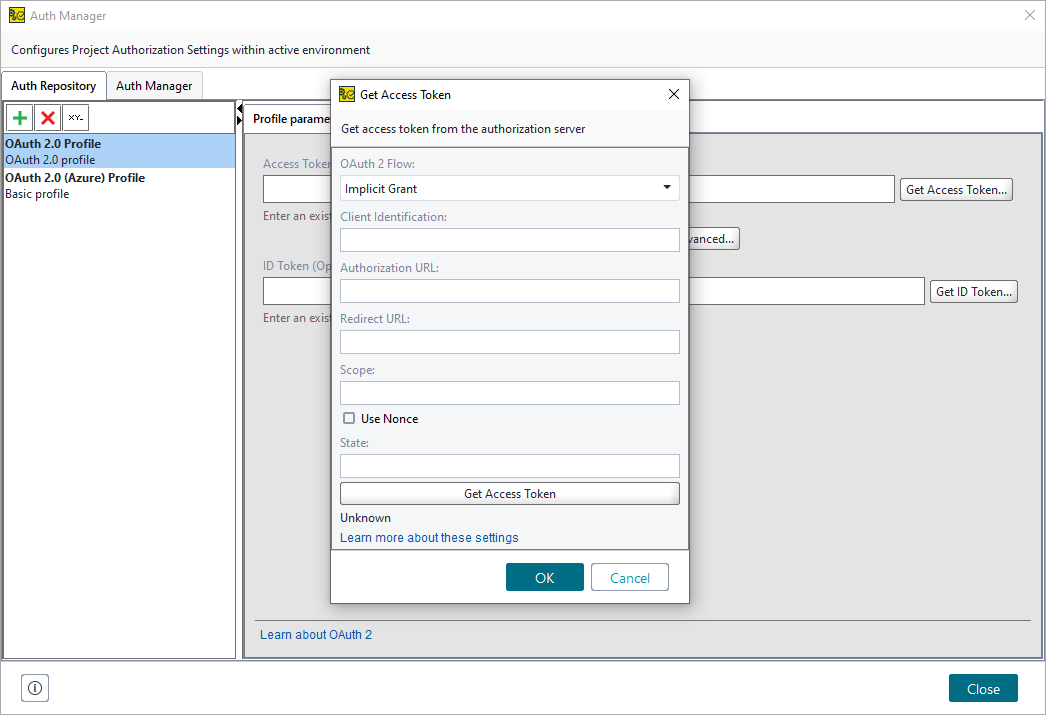
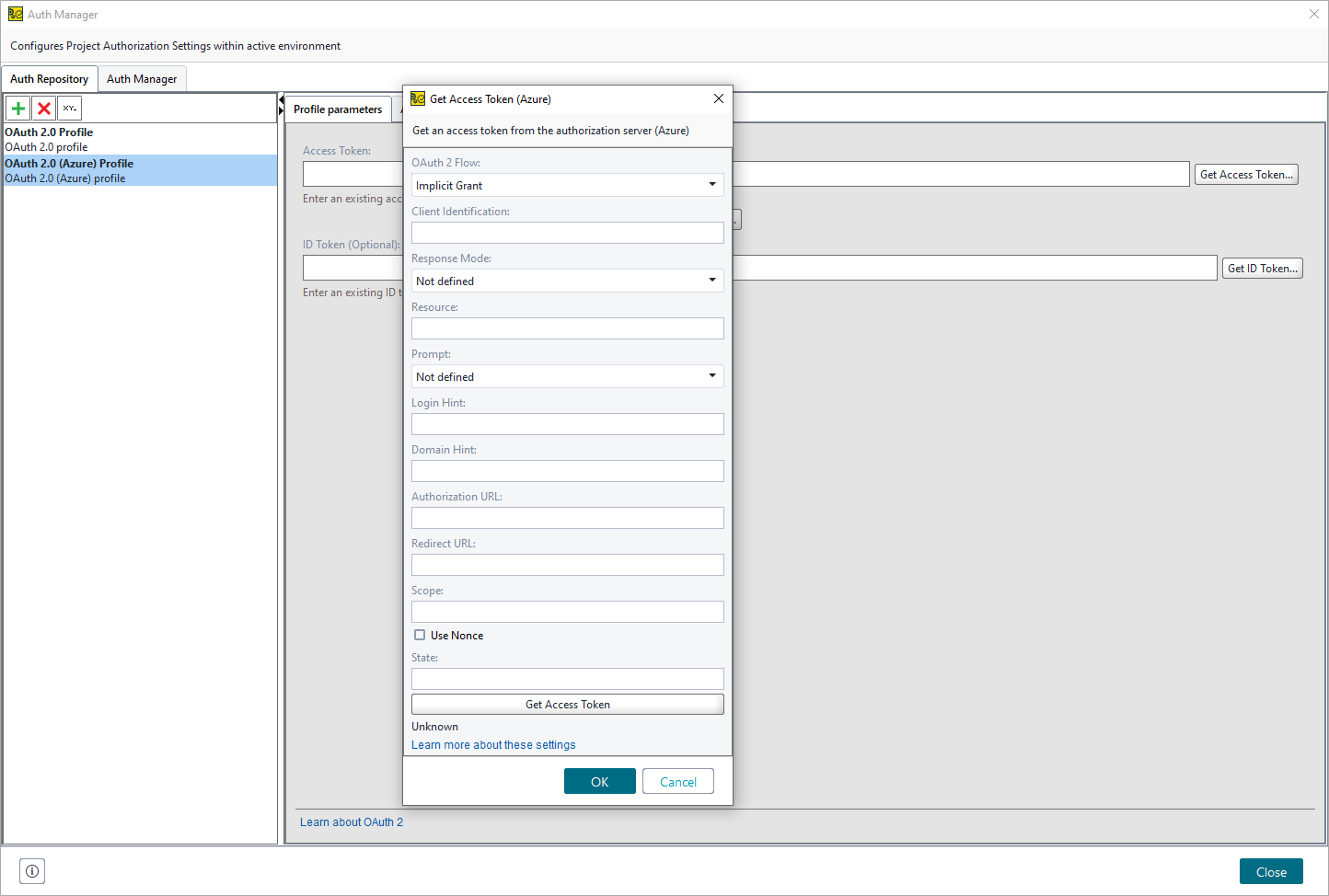
OAuth 2 Flow | The OAuth 2.0 method to use. |
Client Identification | An alphanumeric string that identifies the client. |
Response Mode | (Azure only) Specifies how the authorization server sends the access token. Available options:
|
Resource | (Azure only) The App ID URI of the web service. ImportantMicrosoft Identity Platform v2.0 does not support this parameter. |
Prompt | (Azure only) Specifies whether the authentication server prompts the user to log in or to consent, even when already logged in. Possible values:
|
Login Hint | (Azure only) The string is displayed as a login hint in the sign-in form. |
Domain Hint | (Azure only) Specifies the domain the user should use to sign in. |
Authorization URL | The authorization server URL. |
Access Token URL | The URL to use to get an access token. |
Redirect URL | An authorized redirect URL registered for the application. After successful authentication, the web service redirects you to this URL. For details, see the OAuth 2.0 documentation. TipFor testing, use |
Scope | The full scope string defining the requested permissions. |
Use Nonce | Generates a unique string for each request, allowing the server to verify that a request has never been made before. This helps prevent replay attacks. |
State | The value included in the request is also added to the token response. Use this to generate a random string to prevent a cross-site request forgery attack. |
Get Access Token | Retrieves the access token. |
Automation | Opens the Automated Token Profile editor. |