OpenID Authorization Code Grant
ReadyAPI retrieves the OpenID Connect ID Token in almost the same way as an OAuth 2.0 access token when you use Implicit and Authorization Code grants.
When the Authorization Code grant connect flow runs, the resource owner first provides access. An authorization code then goes to the client through a browser redirect. The client uses it to get an access token. ReadyAPI also sends a refresh token, optionally.
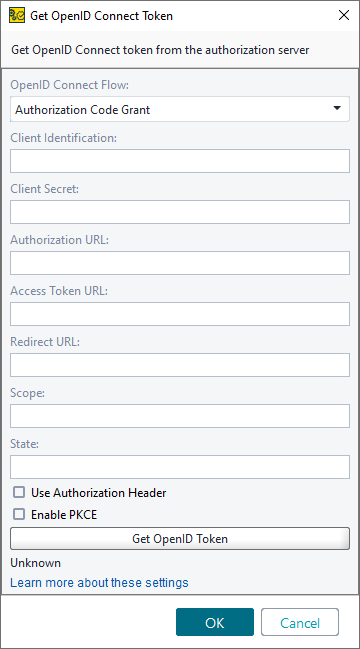 |
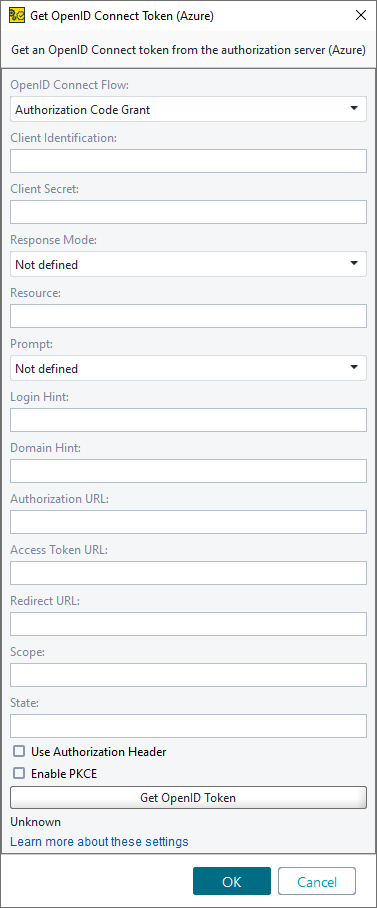 |
Option | Description |
|---|---|
OpenID Connect Flow | The OpenID Connect method to use. |
Client Identification | An alphanumeric string used to identify the client. |
Client Secret | The secret string the client uses. |
Response Mode | (Azure only) Specifies how the authorization server sends the access token. Available options:
|
Resource | (Azure only) The App ID URI of the web service. |
Prompt | (Azure only) Specifies whether the authentication server prompts the user to log in or to consent, even if they are already logged in. Possible values:
|
Login Hint | (Azure only) The string displays as a login hint in the sign-in form. |
Domain Hint | (Azure only) Specifies the domain the user signs in to. |
Authorization URL | The authorization server URL. |
Access Token URL | The URL to use to get an access token. |
Redirect URL | The URL you will be redirected to after successful authorization. |
Audience | Identifies the intended recipient of the token. Some authorization servers require this value to specify the target API or resource that accepts the token. |
Additional Parameters | Custom name–value pairs to include in the OpenID Connect token request. ReadyAPI appends these parameters to the request body and supports property expansion for their values. |
Scope | The full scope string defining the requested permissions. |
State | (Azure only) The value included in the request that the authorization server also adds to the token response. Use it to provide a randomly generated string to prevent a cross-site request forgery attack. |
Use Authorization Header | Select to send client credentials in the request header. Otherwise, the credentials are sent in the request body. |
Enable PKCE | Enables Proof Key for Code Exchange (PKCE) for the authorization request. PKCE adds a security layer by preventing the interception of authorization codes and is commonly required for public clients and OpenID Connect flows. |
Get OpenID Token | Click to retrieve the OpenID Connect token. |
Automation | Opens the Automated Token Profile editor. |